RSS

Monthly Archives: August 2012

Set Your Line Managers Up for Success


I would like to welcome Kyle Lagunas to my blog, as a guest blogger. I am glad to have him share some of his lessons from the field of HR management  – Bhavin Gandhi

In a time when the workforce is increasingly transient, your ability to identify high-performing and high-potential employees—and that of your managers—is critical. And yet, many struggle to distinguish one from the other, negatively impacting their ability to develop and retain top talent. In many organizations, performance is the primary measure of an employee’s value in the organization. Star performers are promoted and rewarded, while diamonds in the rough become disengaged and move on.

Don’t get me wrong–you should definitely value performance. But if your end goal is to build a more robust talent pipeline (and it should be), performance can’t be the only point of entry. To that end, there are strategies that any manager can apply to develop high-potentials and high-performers effectively.

Step One: Identify

High-performers stand out in any organization. They consistently exceed expectations, and are management’s go-to for difficult projects. They take pride in their accomplishments, but may not have the potential (or the desire) to succeed in a higher-level role.

High potentials can be more difficult to identify, especially for line managers. That’s because most valuable attributes (e.g. stress management, adaptability, business sense) aren’t catalytic in entry-to-mid-level roles. Potential is subjective to what a company values, of course, but there are innate attributes that distinguish them from high-performers.

Line managers’ observations are often limited to the most obvious traits (time management, communication skills, attention to detail). By working with leadership, however, managers can profile the skills that ensure success in key roles—and be on the lookout for examples of both high performers and high potentials from day one.

Step Two: Assess

An established standard of the attributes and competencies of model employees is also an essential part of objective assessment. And though there’s a distinct difference between potential and performance, experts agree that employees should be assessed on competency in both.

Each category requires a different development strategy. With a clearer picture of who falls where, managers can make more informed decisions in how to effectively develop them. For example: High Po/ Low Per employees may need to improve their ability to perform consistently, or may be moved into roles better aligned with their natural abilities. And High Per/Low Po employees would be ideal candidates for soft skill development–or for roles that require more technical skill.

Step Three: Engage and Develop

The important thing about development and engagement strategies (especially for high-potential vs. high-performance employees) is to tailor your efforts to drive the results you want. Typical engagement strategies could look something like this:
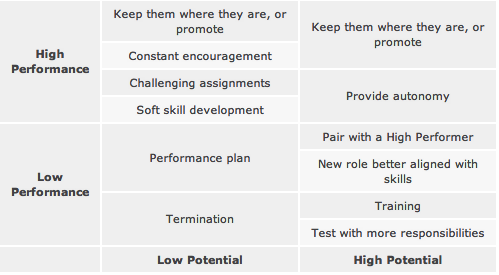
Recognition is key for High Per/Low Po employees. They need constant encouragement and challenging assignments. Rather than promoting them to roles they don’t want (or aren’t ready for), give them the independence and engage them with projects that they can take full ownership of.

Alternately, while High Po/Low Per employees are hungry for more high-impact work, they need seasoning. On the job training is a great way to accomplish this, especially when pairing them with high performers. As they develop a stronger understanding of the organization and their role in it, give them projects to manage, new hires to train, and offer cross-training opportunities.

Set Your Line Managers Up for Success

Your line managers are the gatekeepers to your talent pipeline, and they’ve got their work cut out for them. While most will have some natural ability in identifying, assessing, and engaging performers and potentials, few will be adept at all three. If you want to improve your ability to retain top talent, it starts with your line managers. Set them up for success, and invest in their development.

About the Author: Kyle Lagunas is the HR Analyst at Software Advice—an online resource for HR software comparisions. He reports on trends, technology, and best practices in talent management, with work featured on Forbes, Business Insider, Information Weekly, and the NY Times.

 
Leave a comment

Posted by on August 24, 2012 in 21st Century, Leadership, Management


Tags: , , , , , , , , , , , , ,

How to keep your team motivated in the crunch time?


I am sure, as a manager, you must have encountered a situation where your team has been working very hard for past few months to get that next product out of the door. And due to this situation, everyone in your team feels under-appreciated and overworked. And you don’t know how to keep your team motivated. Does this sound familiar?……..Through this blog, I would try to give you some tips through which you can keep your employees motivated during this crunch time.

Provide feedback: As far as feeling under-appreciated goes, this has to be the #1 killer of team’s motivation. During the crunch time, our focus is so much on the end result that we forget to provide feedback to our team. Sometimes it is very crucial to provide constant feedback to your team on how they are doing. This behavior not only conveys the message that you care for your team, but it also gives you the opportunity to correct any mistakes in your current process.

Communicate purpose: The second biggest killer of self-motivation is negativity. When we set personal expectations at a level that are unattainable, we start to invent reasons for why we are not achieving our goals. We start thinking about past failures that have not gone our way and weak points in our character or at least in our working style. This causes us to come up with all the reasons that we can’t succeed. Hence, to keep your team motivated, you not only need to accept that the timeline given for the project was too aggressive, but you need to also provide them with the reason of ‘why we are doing, what we are doing’. This will provide your team with some background on why you are having these aggressive deadlines, and how it will impact the business, if you don’t meet those deadlines. Also, (if possible) you need to provide them with some blueprint of the plan, so that this doesn’t happen again.

Positive reinforcement: During these tough times, I would recommend you to remember old success stories, and recognize it for what it was. The power of this kind of positive reinforcement and positive feedback can’t be underestimated. Make sure that your team is getting the positive feedback from you that they need. Always make sure to restate your team’s and individual achievements during your team meetings and one-on-one meetings with your team members. This will encourage your team to keep going.

I hope these tips will help you to keep your team motivated in the crunch time. What would you do in this situation? How will you keep your team motivated?

Thanks. – Bhavin Gandhi.

 
5 Comments

Posted by on August 19, 2012 in 21st Century, Leadership, Management


Tags: , , , , , , , , , , , , , , , , , ,

Make your part-time MBA work for you


Have you currently graduated from a part-time MBA program? Do you find it difficult to capitalize on your MBA? Well……you are not alone. Recently, one of my colleague, who has finished her part-time MBA, asked me similar questions. Though she has finished her part-time MBA, she was not recognizing any benefits from it. While I don’t have magical solution to make your MBA work, I have few suggestions which can help you.

Communicate with your manager:

GenerationXIf you are like me, and if you are also working on your MBA while working full-time, then you should communicate your intentions to your manager before you even think of starting the program.

Some of you might be hesitant to share this knowledge with your manager, since you might be afraid to see the reaction from your manager. While some managers will see this communication as an effort from your side to change your existing job, 90% of the manager see this as a potential growth opportunity for their employees.

What can happen here? Either your manager will be impressed by your initiative of pursuing further education to help towards your job, or he will just neglect your entire conversation. Well……you don’t have anything to loose here. But if you don’t have this conversation with your Boss, then you have everything to lose.

I remembered, when I had this conversation with my boss…..he was not only impressed by my decision to improve my knowledge, but he also took the initiative to find out more information regarding the tuition reimbursement program in my company. As a result, I ended up paying only 30% of my total tuition cost for the entire program.

Implement your learning at work: 

Most of the people who pursue their part-time MBA want to get a head in their existing job, so that they can get promoted to the next level. Though the idea behind this thought process is very nice, they lose their focus in middle of the program.

I have seen numerous MBA students, who get busy in their day-to-day coursework that they forget to implement their learning at their workplace. Thus, at the end of their MBA program, they have this knowledge which they can’t apply to their existing job, and hence think of changing their job instead of growing within the same company.

By implementing your learning at your current workplace, you will not only practice your knowledge and get better at it, you will also increase your visibility within your peers. Imagine, if you are working in software company as a software developer and going for your MBA in finance. Though these two subjects are completely different, you can still use your finance knowledge to assess the business impact of your new project. Wouldn’t you look more prepared when you are presenting your next development idea to your VP, and providing him with all the stats on how this project will help the organization to succeed?

Thus, you should always try to find opportunities where you can practice your MBA learning at your work place.

I hope these examples were helpful to uncover the full potential of your part-time MBA program. In the meanwhile, if you have any other ideas through which you can make your part-time MBA work for you, then please feel free to share those here.

Thanks. – Bhavin Gandhi.

 
1 Comment

Posted by on August 8, 2012 in 21st Century, Leadership, Management


Tags: , , , , , , , , , , , , , , , , ,

Why part-time MBA is more worth than a full-time MBA?


Business Week Ranking

This is a long lasting debate. Some people prefer to do a full-time MBA as compared to a part-time MBA. Though you can’t say which one is better over another with utmost certainty, I would recommend part-time MBA for working professionals as compared to a full-time MBA. Obviously, there are various reasons why you want to do a part-time MBA, but some of the primary reasons are as follows:

Cost savings: Unless you got accepted to an Ivey League University for your full-time MBA, I would recommend you to do your part-time MBA from some local University. It will save you some tremendous amount of money. Let’s say, if you were to do your full-time MBA from some University. In that case, you had to quit your job for couple of years. Let’s say, you are earning $50,000/year right now. That means, you are losing $100,000 in two years of your education period, because you won’t be working full-time during that time. In addition to your loss of income, you have to pay for the tuition from your own pocket, which might be anywhere between $50,000 to $200,000. In short, you would be losing on an average around $150,000 ($100,000 + $50,000) during these 2 years of your full-time MBA. Let’s say, you somehow magically find a job in this economy with your full-time MBA, which pays you $15,000 more than your previous salary, then also you will take at least 10-15 years to cover that cost. Isn’t that right?

Minimal risk: Other than the huge cost savings, part-time MBA comes with other additional advantages. And one of the most important advantage is – minimal risk. If you are a working professional, then chances are …… your current employer might be covering partial or full cost for the entire program. Thus, you don’t have to come up with the tuition amount from your pocket. Let’s say, you started your program and in the middle of it, you somehow didn’t end up liking it. In that case, you can just quit, since you haven’t invested much of your personal money in this initiative. In addition to this, you don’t have to spend much time studying for GMAT or GRE, since most of the part-time programs (like Harvard Extension School) offer few classes as Grad Special, and if you perform well in those classes then you get to enter in to the program without giving your standardize tests. This will ensure that you like the program before you actually get admitted in to one, unlike the full-time MBA program.

Understand the other side: When I first thought of doing my MBA, I wanted to do it to understand what my Boss does. Being from a technical background, I always had a problem understanding the strategic decisions taken by my company. I was much more involved in the technology as compared to the business behind it. My part-time MBA provided me with the opportunity to understand the business perspective better. I am not saying that I couldn’t have learned the same thing through full-time MBA, but if I were in the full-time MBA program, then I wouldn’t have the opportunity to connect this learning to the current work environment. Most of the times, I would learn something from my MBA classes, and I was able to directly apply that learning at my work place. And that has helped me retain approximately 60% of my concepts, which I wouldn’t have otherwise remembered due to lack of practice. And maybe, this is the key reason why one should prefer part-time MBA over full-time program.

I hope these tips will help to choose between full-time and part-time MBA program. Do you have any other reasons due to which you would prefer a part-time MBA program over a full-time option?

Thanks. – Bhavin Gandhi.


Tags: , , , , , , , , , , , , , , , , , , ,