RSS

Tag Archives: Leaders of Tomorrow

How to provide coaching to an experienced employee in your team?


Coaching Experienced EmployeesMost of the managers think that their experienced employees, who are in their team from a long time, doesn’t require any coaching. If you are one of those managers, then let me stop you right there. You are completely wrong. In fact….your experienced employee will require more coaching than your new employee, since he is the one who will be defining the normal of your team, and maybe, become a mentor to your new employee. Right? Obviously, you will require a different coaching style to coach your experienced employee as compared to your new employee (as I have indicated in my last blog). Thus, in this blog I will provide you with few pointers to coach your experienced employees.

Before I provide you with any strategies to coach your experienced employee (Mr. Y), let’s define what we expect from our experienced employees………We expect our experienced personnel to work on special projects and expand their circle of influence outside of your team, so that they can resolve few mission critical issues without your intervention. We also expect them to take ownership of few projects, and solve mission critical issues on their own. Some of the other expectations would be……training a new hire, defining new processes to improve efficiency, etc. Am I right?

Since we depend on our experienced employees to get the job done and improve the productivity of our team, their coaching style needs to be very personalized and effective. Following are few strategies that I use with my experienced employees…….

  1. Provide exposure: Since you already depend on Mr. Y; wouldn’t it be nice, if he can communicate directly with the cross functional team members, so that you can get the expected results? In order for Mr. Y to communicate with appropriate members from other teams, you need to provide him with various opportunities to work on cross-functional team. You can also provide company-wide exposure by introducing him to persons and areas beyond his current expertise. Sharing your larger network with him would be even better.
  2. Provide time: Let’s say, you give Mr. Y with the responsibility to lead a project from development to implementation, or provide him with the opportunity to coach others. In both of these cases, you need to be slightly patient to see the outcomes from those efforts. Since, these responsibilities are very new for him, he will take some time to learn and adjust to these responsibilities. Hence, don’t be frustrated, if you don’t see quick results. Provide him with some time to adjust to these new responsibilities, while closely monitoring his progress and providing needed help along the way.
  3. Teach them to delegate: Since Mr. Y is an experienced employee, you might be using him for very special projects, and hence, his knowledge might be very specialized and rare. In order to coach him effectively, you need to teach him how he can delegate his tasks and transfer his knowledge. You need to encourage him to “let go” his activities and expertise to give others the opportunity to be an “expert”.
  4. Provide training: You should involve your experienced employee in the selection, development and planning efforts, so that he can learn your style of decision making, and hopefully, use that knowledge to make future decisions on his own. His involvement in decision making will not only help you to get better informed with the day-to-day issues on the line, but it will also give him the opportunity to learn how mission critical decisions are taken. If your employee is inexperienced in coaching others, co-coach your new employees with him. This will give him the confidence in coaching others, while improving your trust relationship with him.

I hope, these tips will help you to better coach your experienced employee in your team. Stay tuned for my next blog, where I will provide you with some pointers on how to coach your managers. In the meanwhile, if you have any other ideas through which you can provide effective coaching to your experienced employees, then please feel free to share it here.

Thanks. – Bhavin Gandhi.

 
Leave a comment

Posted by on February 7, 2013 in 21st Century, Leadership, Management


Tags: , , , , , , , , , , , ,

How to provide coaching to a rookie in your team?


Coaching a Rookie in your teamOne of the most important duties of a Manager/Leader is to coach their employees to get the desired business results. Like….one management style doesn’t work for everyone, one coaching style doesn’t function for everyone. Depending on your employee’s experience and historical background, you have to customize your coaching style to get the best out of themselves. Right? In this blog post, I will provide you with few pointers through which you can effectively coach your new hire.

Before I provide you with any strategies to coach your new employee, let’s find out few challenges that they would face as a new hire………As a new hire, your employee (Mrs. X) would require clear direction on what she is supposed to do, right? She will also need some clearly defined work assignments, where she can get herself acquainted to your company and its processes, am I not right? Obviously, she is new to the company, so she will also need your help to expand her circle of influence to get the work done.

Since, we are clear on what challenges she would face as a new employee in your team, now we can go ahead and define some coaching strategies. Following are few strategies that I use with my new hire…….

  1. Frequent feedback: As a new employee, she would not know if she is doing the assigned task appropriately and up to your expectations. And hence, providing frequent reviews and feedback is a must.
  2. Set clear expectations: In order to make sure that she can be productive quickly, you need to provide clear and detailed instructions for every basic tasks that you assign to her. It would be better for you, if you can provide her with smaller projects with clearly defined start and end times. This will make sure that you educate herself with your team’s processes while meeting your productivity targets at the same time.
  3. Ask questions:  In order to make sure that you are strengthening your relationships with your new employee and she is getting all the information that she needs, you need to regularly ask her questions. Questions like……. “How are you doing?”, “Do you have time for lunch?”, and “How do you like our team?” will help you to strengthen your relationship with her and to build your initial trust. On the other hand, questions like…….”Are you getting the information you need?”, “Are you meeting the right people?”, and “Let me know, if you need anything” will help her to make sure that she gets the work done.
  4. Assign a coach: Obviously, you would be introducing her to your team and encouraging her to increase her circle of influence within and outside of your team. But sometimes that is not enough. You need to explicitly assign a member of your team, who is willing to coach her. This strategy will not only help her to get herself acquainted with your team’s processes, but it will also give your experienced employee an opportunity to showcase his talents to you. With an explicit coach assigned to her, she can now learn your processes, languages, and acronyms used in your area without your explicit time given to her.

I hope, these tips will help you to better coach your new hire in the team. So, what would you do differently to coach your new employee? Do you have any other ideas to effectively coach your rookie?

Thanks. – Bhavin Gandhi.

 
2 Comments

Posted by on January 22, 2013 in 21st Century, Leadership, Management


Tags: , , , , , , , , , ,

How to manage your Chinese employees effectively?


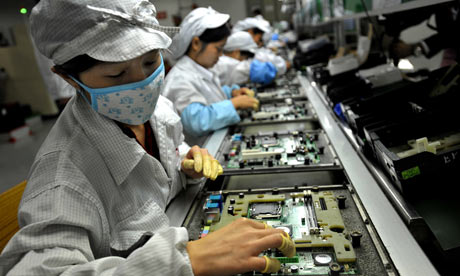
Chinese employees working in a manufacturing plantMy first real exposure to China and Chinese employees was in the early 2009, when my company decided to open its research and development center in Beijing, China; and put me in charge of newly developing system automation team in China. Since then, I have worked with Chinese employees extensively, either it’s at my current job or at some of the smaller companies that I have consulted over the years. Though I am still in the process of learning more about the Chinese culture, one thing is clear, the leadership style of the Western Countries is not effective when you work with Chinese employees. Thus, in this blog post, I would provide you with some insight on how to effectively lead your Chinese employees.

Management style: In developed countries like the United States, we provide opportunities to our employees to resolve problems/issues by themselves. While this kind of strategy (delegate and disappear) is very effective in developed countries, it doesn’t work well with Chinese employees. Chinese people are very traditional, they respect authority and are introverts in some cases. So, they will depend on you to take critical decisions of the project that you have assigned to them. In order to work better with them, you might want to …….(1) Stop by their desk or video conference them at least 1-2 times a day, and ask for blocking issues with their projects ……….(2) Have frequent team meetings to go over critical issues …….(3) Make their introductions to all of the stakeholders of the project, so that they can feel comfortable going to them directly instead of coming to you for smaller issues ………(4) Develop personal relationships with them. Strong relationships can help you go a long way.

Obtaining Information: Similar to adjusting your management style, you might need to change the way you communicate. Let’s say, if you are trying to get some information from a Chinese manager, and if this is your first time communicating with him, then you might want to utilize your contacts at similar levels in the organization to get that information. In most of the cases, information may not flow downward through the hierarchy as easily as one might expect, when the culture of the company is less hierarchical. In order to get the correct information on the right time, you might want to cultivate your informal contacts within your Chinese branch. And yeah! Always make sure to rephrase your understanding of the issue/solution, once you get the desired information. This practice will ensure that you are on the same page with your Chinese counterparts. Sometimes, language barrier can create various problems.

Presenting Information: Chinese culture is very status-oriented. Let’s say, you are a manager in the US company, who manages the offshore team of 10-12 Chinese employees. Now, assume that you want to change your current process. I bet you……when you will present your new plan to these employees, you will get very minimal or no feedback. Due to their status-oriented culture, there may be less feedback from the audience during a presentation than one might expect in a more equality-focused culture. And hence, I would recommend you to give them the opportunity to provide their feedback later through an e-mail or an anonymous forum. In most of the cases, they feel very comfortable in providing their feedback to their superior in a private setting as compared to a public setting.

I hope, these tips can help you to become a better manger, when you are working with a Chinese team. What other changes would you make in your management style, while working with Chinese employees?

Thanks. – Bhavin Gandhi.


Tags: , , , , , , , , , , , , , , , ,

Did you get promoted to a management position for the first time? Then stop doing what you know. Find out why.


After seven years in software development at a San Francisco based e-commerce company, my friend (let’s call him Mr. X) was promoted to his first manager’s position as an Engineering Manager. Up to that point, his track record had been stellar. His intelligence, focus, and determination had won him recognition and various promotions in his organization.

When his company assigned him to be the engineering manager for one of the company’s hottest new products, he ran into trouble early on. Mr. X’s past successes were due to his extraordinary technical leadership and programming capabilities. Accustomed to programming, he was a control freak and had the tendency to micromanage. His efforts to micromanage the engineering team alienated them. And within few months, Mr. X was back as being a technical leader (sr. programmer) and someone else was leading the team.

Mr. X failed as an engineering manager because he was unable to make the transition from being a strong individual programmer to an engineering manager. He failed to grasp that the strengths which had made him successful during his sr. programmer role could be liabilities in a role that required him to lead an engineering team by trusting their programming skills instead of doing it yourself.

What might Mr. X have done differently? He should have focused on mentally promoting himself into the new position, a fundamental challenge for new leaders. The one thing to remember is…………..you can’t become successful in your new job as a manager by continuing to do what you did in your previous position as an individual contributor.

Since you might have been promoted due to your skills and accomplishments, it is only human to think that your senior management wants you to do what you were good at. Maybe that’s the only reason why you might live in the denial, and believe that you are being productive and efficient, if you continue your old behavior. But instead of continuing your responsibilities as an individual contributor, you need to prepare yourself mentally to move into your new role by letting go of the past and embracing the imperatives of the new situation to give yourself a running start. This can be hard work, but it is essential that you do it.

I hope, this blog comes to you as a reminder to forget what you knew, and try adapting yourself to the new management role that you have inherited. What would you do in this situation, if you were to be promoted to your first ever management job?

Thanks. – Bhavin Gandhi.

 
Leave a comment

Posted by on November 13, 2012 in 21st Century, Leadership, Management


Tags: , , , , , , , , , , , , , ,

Is your e-mail signature helpful to others? – Designing your perfect e-mail signature


Have you ever been in a situation, where you have got an e-mail from a long gone friend without any contact information about him? I am sure, most of us must have received at least one e-mail in their lifetime, which is from their close friend, but it doesn’t provide any information on how to contact them. Let’s take this for an example……Mr. X, who was your close college friend, suddenly sends you an e-mail about few things that he might want to discuss with you. What will you do in that situation? You might want to call him, but there is no contact information provided by him (no signature in his e-mail). And hence, you would rather be satisfied by responding to his e-mail instead of finding his contact information in your address book and calling him. Is that not right?

Imagine the similar situation at your workplace. Let’s say, you get an e-mail from Mrs. Y, who works in the different department, requesting specific information from you. Let’s say, you don’t have any idea on what she is asking for. So, instead of calling her (since she doesn’t have her contact information in the email signature), you would respond to her e-mail, and she might have to wait for few hours to clarify her side through to-and-from e-mail communication. Due to this long chain of e-mails, she will end up losing precious time to resolve the issue at hand. Imagine, if she would have included some basic information about herself with the contact information. Wouldn’t your response be different in that situation? Let’s say, if she would have put that she works in the licensing department as a project manager for XYZ. I am sure, this information would have helped you to put her e-mail in some context, and your response would have been much more quicker and informative.

So, how do you avoid these situations? What kind of information should you be putting in your e-mail signature? Well……..answer is very simple. You should include your name, your designation, your company’s name, your work address, your work e-mail, your work phone number, your work mobile number (if any), and your professional picture (if possible). Your name and designation should help your responder to put your e-mail in some context. Your work address might be useful, when your responder might want to mail something in response to your e-mail. Obviously, your e-mail address and phone numbers would be very handy for your responder, if they want to reach you quickly. And yeah! Though your professional picture is optional, I would highly recommend you to upload that on your Outlook or embed in your e-mail signature. Professional profile picture helps your responder to remember you by the face.

If I were you, I would have my e-mail signature as follows. Also, note that all of the contact information provided below is fake, and hence, please don’t contact me through that contact information. You can rather reach me through my ‘Contact Me’ page, which contains various ways to connect with me.

Sample E-mail Signature

I hope, these tips will help you to design your perfect e-mail signature, which can help your responder to get all the information that they need, in order to quickly respond to your e-mail. Do you have any similar tips like this, which can make your e-mail communication effective?

Thanks. – Bhavin Gandhi.

 
Leave a comment

Posted by on November 6, 2012 in 21st Century, Leadership, Management


Tags: , , , , , , , , , , , ,

How to communicate tough strategic decisions to your stakeholders?


Have you ever been in a situation where you needed to layoff someone? Or imagine yourself in a situation like Yahoo!, when their CEO resigned and no one knew where the company was going. How would you have handled that situation as a leader? No matter how hard you try to keep your employees safe from the corporate decisions at the top, sometimes those decisions will affect your employees regardless of your efforts. So, how will you handle those situations? In this blog, I will provide you with few pointers through which you can communicate these tough decisions to your employees very easily.

Announcement meeting: After a decision has been made, the communication to the outside world and the larger community of workers has to be handled with firmness, transparency and candor. Let’s say, your CEO resigned, and you only communicated the news through an e-mail. Chances are……….your employees will have lot of questions about the company’s future, and there is no interactive way to address those concerns. Thus, I would recommend you to have a conference call (or a meeting) with your line managers, before various rumors start churning. And yeah! While doing this, provide them the opportunity to ask their questions. Answers to their questions will make your strategy clear in their minds, and hence, they would be able to communicate that to their employees very easily. Encourage all of your line managers to have a quick sync-up meeting with their employees to communicate this decision with their employees. If possible, have a company-wide hands-on meeting 2-3 days afterwards.

Communicate with media: Imagine, if your company had a big layoff, and you heard about this news from the media. How will you feel in that situation? In the similar manner, your employees will feel cheated, if they heard this kind of a news from the media, instead from their supervisor. And hence, it is very important to communicate these decisions within your organization, before you go public. News conferences and news releases should be given only after talking with the staff . The staff should not read about it first in the media. You need to also make sure that the media doesn’t hear about this news from the grapevine. Thus, you should keep a very small time difference between notifying this news to your employees and the media.

Notify other stakeholders: If you are laying off few people, then you might want to talk with relevant governmental agencies to notify them about the decision. If your company buys any kind of an unemployment insurance, then you definitely want to make calls to those insurance providers for notifying them about the situation. If your decision is affecting any of your commitments to your customers, you might want to talk to them immediately. Obviously, you need to notify your customers, suppliers and the community leaders through an e-mail and/or a conference call. And yeah! Don’t forget to define your future plans in your communication. I have seen many notification e-mails with the description of the problem without any clear path for the future. So, do yourself a favor, and define your future path before you go ahead with any of these communications.

I hope, these tips will help you to communicate any tough strategic decisions to your stakeholders. If you have any other ideas through which we can communicate these kind of news through transparency and sensitivity, then please feel to share it with me here.

Thanks. – Bhavin Gandhi.

 
Leave a comment

Posted by on October 29, 2012 in 21st Century, Leadership, Management


Tags: , , , , , , , , , , , , ,

Why should you listen to your employees while taking tough decisions?


It is never easy to deliver the bad news to your employees, but bad things can happen to any companies. Sometimes, few external factors like economy or exchange rate can affect your company’s bottom line. And at that time, company’s very survival might be at stake. And hence, you might be put in to the situation, where you have to take those tough decisions as a company’s executive. The primary challenge during these situations is – Communication. If handled incorrectly, you might risk of losing your employee’s trust and tumbling their morale. In this blog, I would like to share one of the success story, where listening to employee’s input while taking these tough decisions have helped the company.

While taking tough decisions such as layoffs, restructuring, outsourcing, etc.; you should involve your stakeholders in the planning and implementation stages. You might not be able to involve all of your employees while taking these tough decisions, but you should at least engage your senior management and department heads in the consultation process. Depending on the situation, you might want to keep employees/employee representatives apprised of the situation to avoid any surprises. On various occasions, this strategy might prove to be helpful.

Take this company for an example (company X), where I recently consulted them for downsizing. Company X had really bad financials. It was clear that they had to cut down two of their product lines, which were not performing at all. And hence, they had to layoff few of their employees due to tumbling financial situation of the company. So, instead of announcing few layoffs, the CEO announced voluntary retirement program and some pay cuts. Surprisingly, I was able to collaborate with majority of their employees and get them to agree upon a pay cut and retraining program. As a result, we didn’t need to layoff anyone. Though this was a success story, it might not work for everyone. But one thing is clear. If you are willing to share information with your employees, they will not only value your decision but they might also come up with a plan to handle the situation better.

I hope, this example can inspire you to consider your employee’s input while taking these critical decisions. Have you ever encountered similar situation like this? Are you aware of any workplace/organization that considers their employee’s input before taking tough decisions?

Thanks. – Bhavin Gandhi.

 
Leave a comment

Posted by on October 24, 2012 in 21st Century, Leadership, Management


Tags: , , , , , , , , , , , , , , ,

Why shouldn’t you let your poor performer slide?


Oftentimes, as a manager we believe that as long as project goals are being met, we can let poor performers slide. Handling poor performers can not only consumes lot of time; but if handled incorrectly, it can create a hostile work environment for your other employees. After all, no manager is looking forward to have a difficult conversation with their employees, especially in a crunch time. But if you keep ignoring these poor performers then it can create a disastrous situation for your team. You might encounter following consequences, if you refuse to deal with your poor performers.

Decline in your team’s productivity: Let’s say, Joe is your go-to guy, and a good performer. Let’s say, Steve is your poor performer in the team. Joe is monitoring Steve’s performance from last 2 months, and he sees that even if Steve’s performance is bad from last 2 months, their manager is not taking any action to correct his behavior. So, now Joe may begin to wonder what the point is of his extra efforts and working overtime. Due to the multiplicity effect of this behavior, you will have a team of 60% poor performers within few months.

High turnover rate: When your poor performers are not working, your good employees are working twice as hard as usual to keep projects on track or to correct the mistakes of the incompetent employee. If your poor performer doesn’t face any consequences from you, your good employees can lead to resentment, unhappiness, and, eventually, leave your team to seek employment elsewhere.

Creation of rumor mills: If your go-to guy (Joe) keeps on seeing that the incompetent employee is getting away with his poor performance for months, then he might think that your poor performer (Steve) might have connections with upper management. It’s human nature. When we see any wrong action from someone without any consequences, we try to think up number of reasons for justifying that behavior. In my example, some of the rumors that can stat are….What does so-and-so have on the manager? Why is everyone so afraid to reprimand so-and-so? Etc.

Though it is very difficult and unpopular to deal with your poor performers, it is your utmost responsibility, as a manager, to address these performance issues as soon as they are noticed. This practice will help you to avoid problems in the future and create a healthy work environment for your team. I hope, this blog came to you as an eye opener, so that you can handle your poor performers in the future. Let me know, if you know of any other issues that your poor performer might create. Thanks – Bhavin Gandhi

 
Leave a comment

Posted by on October 15, 2012 in 21st Century, Leadership, Management


Tags: , , , , , , , , , , , , , ,

Become the best leader by being funny and being humiliated


Over the years, I have learned a lot about leadership and management. And when I was analyzing my knowledge, I realized that there are only two very important characteristics of a good leader, which separates him/her from the crowd. In this blog, I will focus on these two characteristics, which can make you the best leader.

Be funny:

By being funny, I don’t mean that you need to be a superstar at the break room discussions. What I mean is……..you need to have a humorous side of you to laugh on your mistakes.

One of the best leader in the world, who implemented this strategy was – Mahatma Gandhi. It must have taken tremendous amount of courage for a person like him to confess that he messed up, but he confessed his mistakes on various occasions. He not only acknowledged his mistakes but admitted them publically. And this was one of his characteristics, which was admired by his peers.

We are all humans, and we all make mistakes. But a true leader is the one, who not only admits his mistakes but learns from it. Take Johnson & Johnson for example. Their Tylenol incident is not a secret to anyone, but majority of people remember that incident by praising Johnson & Johnson’s effort of recalling all of its medicine from the counter and apologizing publicly for this huge mistake.

Thus, it is very critical for you as a leader to be able to laugh on your mistakes. It’s not enough to just publicly admit your mistakes. Make sure to take some notes. In this way, you will be able to implement your learning from this incident to the future projects, and maybe, not repeat these mistakes again.

Be humiliated:

If you want to become the best leader in the world, then you need to surround yourself with genius employees. Look at Steve Jobs, Bill Gates, etc. They have always surrounded themselves with cream employees.
Let’s say, you somehow get successful in attracting best-of-the-best employees in your team. Now, instead of learning from them and taking benefit of their knowledge, if you direct them specifically to do certain tasks then they are never going to add any value to your organization.

Unfortunately, 40% of today’s leaders would use tell-and-direct approach, since they fear of humiliation from their employees. While this approach might lead you to the desired results, you are suppressing ideas of improvements that your employees might have. Wasn’t this the exact reason why you hired intelligent workforce? So, how come we are unable to use their talents? Answer is very simple……most of the leaders are afraid of being humiliated by their employees.

Thus, to become the best leader, we should be open to new ideas of our employees, even if, that means we will look foolish in front of them when we ask questions. By developing this kind of an environment, you would be encouraging your employees to share knowledge freely, and hence, improving the overall health of your company.

I hope these tips will help you to become the best leader in today’s world. Do you have any other ideas through which a person can become the best leader?

Thanks. – Bhavin Gandhi.

 
2 Comments

Posted by on September 18, 2012 in 21st Century, Leadership, Management


Tags: , , , , , , , , , , , , , ,

Set Your Line Managers Up for Success


I would like to welcome Kyle Lagunas to my blog, as a guest blogger. I am glad to have him share some of his lessons from the field of HR management  – Bhavin Gandhi

In a time when the workforce is increasingly transient, your ability to identify high-performing and high-potential employees—and that of your managers—is critical. And yet, many struggle to distinguish one from the other, negatively impacting their ability to develop and retain top talent. In many organizations, performance is the primary measure of an employee’s value in the organization. Star performers are promoted and rewarded, while diamonds in the rough become disengaged and move on.

Don’t get me wrong–you should definitely value performance. But if your end goal is to build a more robust talent pipeline (and it should be), performance can’t be the only point of entry. To that end, there are strategies that any manager can apply to develop high-potentials and high-performers effectively.

Step One: Identify

High-performers stand out in any organization. They consistently exceed expectations, and are management’s go-to for difficult projects. They take pride in their accomplishments, but may not have the potential (or the desire) to succeed in a higher-level role.

High potentials can be more difficult to identify, especially for line managers. That’s because most valuable attributes (e.g. stress management, adaptability, business sense) aren’t catalytic in entry-to-mid-level roles. Potential is subjective to what a company values, of course, but there are innate attributes that distinguish them from high-performers.

Line managers’ observations are often limited to the most obvious traits (time management, communication skills, attention to detail). By working with leadership, however, managers can profile the skills that ensure success in key roles—and be on the lookout for examples of both high performers and high potentials from day one.

Step Two: Assess

An established standard of the attributes and competencies of model employees is also an essential part of objective assessment. And though there’s a distinct difference between potential and performance, experts agree that employees should be assessed on competency in both.

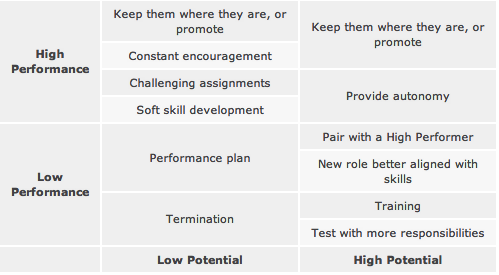
Each category requires a different development strategy. With a clearer picture of who falls where, managers can make more informed decisions in how to effectively develop them. For example: High Po/ Low Per employees may need to improve their ability to perform consistently, or may be moved into roles better aligned with their natural abilities. And High Per/Low Po employees would be ideal candidates for soft skill development–or for roles that require more technical skill.

Step Three: Engage and Develop

The important thing about development and engagement strategies (especially for high-potential vs. high-performance employees) is to tailor your efforts to drive the results you want. Typical engagement strategies could look something like this:

Recognition is key for High Per/Low Po employees. They need constant encouragement and challenging assignments. Rather than promoting them to roles they don’t want (or aren’t ready for), give them the independence and engage them with projects that they can take full ownership of.

Alternately, while High Po/Low Per employees are hungry for more high-impact work, they need seasoning. On the job training is a great way to accomplish this, especially when pairing them with high performers. As they develop a stronger understanding of the organization and their role in it, give them projects to manage, new hires to train, and offer cross-training opportunities.

Set Your Line Managers Up for Success

Your line managers are the gatekeepers to your talent pipeline, and they’ve got their work cut out for them. While most will have some natural ability in identifying, assessing, and engaging performers and potentials, few will be adept at all three. If you want to improve your ability to retain top talent, it starts with your line managers. Set them up for success, and invest in their development.

About the Author: Kyle Lagunas is the HR Analyst at Software Advice—an online resource for HR software comparisions. He reports on trends, technology, and best practices in talent management, with work featured on Forbes, Business Insider, Information Weekly, and the NY Times.

 
Leave a comment

Posted by on August 24, 2012 in 21st Century, Leadership, Management


Tags: , , , , , , , , , , , , ,