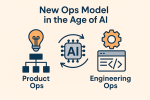
When I first saw teams experimenting with AI before it became cool, the behavior felt really familiar. It reminded me of how teams treated Agile in the early days, something you “use/follow” rather than something that fundamentally reshapes how work flows. Teams were excited, curious, and well intentioned, but almost everyone was underestimating the change in front of them.
At larger enterprises like GE and Schneider, operations always lived a layer below the visible product surface. Customers never see the spreadsheets, the JIRA workflows, the dependency maps, or executive readouts, but those invisible systems determined whether strategy delivered the outcomes that we were looking for. AI is now inserting itself directly into that invisible layer.
Most teams today are using AI as a chatbot. They paste in meeting notes, ask for summaries, maybe generate a PRD draft or clean up status language. That’s fine, but it’s also like using a high performance engine only to power the radio. The real power shows up when AI becomes part of how decisions get made, not just how words get written.
I saw a version of this contrast clearly when working with startups versus large enterprises. Startups rarely debate whether a process is “ready.” They automate thinking early because speed leaves no alternative. In contrast, large organizations often wait for certainty, governance, and sign‑off, which delays leverage. AI flips this dynamic. For the first time, large companies can gain a startup‑like operational awareness without burning people out.
The biggest mental shift is this: AI is not just another productivity tool, it is an operating layer that sits between data and action. Every organization already has raw inputs: roadmaps, sprint plans, incident logs, metrics, emails, Slack threads. What most lack is synthesis at scale. Humans do this manually, inconsistently, and too late. AI changes that.
One of the most effective early experiments I have seen is when we stop asking AI to “do work” and start asking it to “explain the system.” Thus, I often ask questions like: What changed this week that mattered? Where are we accumulating hidden risk? What assumptions are we acting as if they are true, but haven’t validated recently? These questions help me sharpen my approach and provide insights that I can quickly review and validate with my organization’s strategy.
Another practical way to begin is to deliberately wire AI into your operating cadence. For example, before every weekly program review, I feed my model JIRA updates, dependency map, and roadmap changes. After that I ask it for a narrative and compare it against my overall understanding of the program. This approach has helped me cut down my manual tasks by almost 40%. Recently, I have started providing some additional context to my model and started asking it what tradeoffs it will make based on the information and using that to improve program’s execution. If you follow this approach, then overtime AI will become your partner and help you expedite decision making.
I believe that the teams that win with AI won’t be the ones who generate content faster. They will be the ones who design systems where insight appears earlier, decisions happen cleaner, and surprises shrink. This isn’t a tooling upgrade, it is an operating model shift.











TPMJordan
May 12, 2026 at 12:16 PM
Really informative blog. Can you provide more examples about how I could use that in my day to day life, if I don’t work at your level and most of my duties are gaining alignment and helping execution at my team level?
Bhavin Gandhi
May 12, 2026 at 6:07 PM
Great question, Jordan.
There are several ways TPMs at the team level can add value, especially if JIRA is your execution engine. For example, you could use JIRA AI, Rovo, to generate a narrative of how a sprint is progressing. If that narrative doesn’t align with your ground reality, it becomes a great signal to dive deeper and engage the right stakeholders to address risks.
You could also explore building an agent to help product owners break down Epics more effectively based on your team’s context, or leverage historical data to train models that provide more accurate story point estimates.
Overall, there are many opportunities to evolve your workflows and make them more impactful for your teams. I will be sharing more examples like these in upcoming posts. I would love for you to follow along and stay engaged.