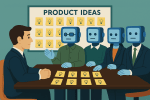
During my second week at Facebook, mid-pandemic, onboarding remotely into the VR org, I joined a product review where a PM spent more time challenging their own proposal than defending it. Before anyone else could question it, they walked through what might break, where adoption could fail, and what risks Legal or Infra would raise. By the time feedback started, most of the obvious objections had already been addressed.
That was my first real glimpse into how the strongest product managers operate. They don’t just present ideas, they argue with them. I have seen similar behavior in startups, but there it usually comes from necessity, limited resources force sharper thinking. In Fortune 500 companies, this kind of rigor comes from discipline.
That’s where AI changes the game today. AI gives every PM a first-pass sparring partner, but only if you use it the right way. Today, most teams use AI to generate PRDs, architecture docs, epics, and user stories. That’s useful, but it misses the point.
The real leverage shows up when AI becomes the voice that challenges you: “Here’s what you might be wrong about.” It’s particularly effective at surfacing blind spots like downstream dependencies, operational risks, users you overlooked, or costs that don’t show up in feature narratives.
Over the past few years, I have coached many PMs to use AI differently. Instead of asking it to generate output, we trained AI to think like stakeholders. At Amazon, for example, we created detailed personas for 3rd party sellers, engineering leaders, legal, finance, marketing, and operations teams. PMs would then prompt AI to respond from those perspectives:
- What would Legal push back on?
- How would Finance evaluate this investment?
- What risks would Operations flag?
- What architectural dependencies could delay the launch?
Early on, the outputs had rough edges. But as models improved, this approach became increasingly powerful, because product decisions rarely live in isolation.
One PM I worked with used this exact approach while planning a new seller facing feature. On the surface, it looked straightforward, improving onboarding flows to increase seller activation. The PRD was clean, the metrics were strong, and engineering had already sized it.
Before finalizing, we ran the idea through stakeholder based AI prompts. When prompted as “Legal,” AI flagged a potential compliance issue with how seller data was being surfaced across regions. When prompted as “Finance,” it highlighted an unaccounted cost in supporting international payment reconciliation. And from an “Operations” lens, it exposed a spike in expected support tickets due to onboarding ambiguity in edge cases.
None of these were obvious in the original proposal. Catching them early avoided what would have likely been a delayed launch and a much more expensive fix post-release. That’s the real value.
Over time, PMs who use AI this way will produce sharper, clearer proposals, not because AI wrote them, but because weak thinking was exposed earlier, grounded in data and organizational context. Thus, AI becomes a forcing function for rigor. And that leads to a broader implication: Product excellence has never been about output volume. It has always been about decision quality and the outcomes those decisions drive.
AI is now raising the bar for decision hygiene and quietly exposing teams that rely on intuition without validation.