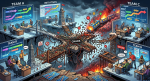
A few years ago, I was in a Roadmap Planning Onsite in a room full of incredibly smart, driven people, the kind of team any company would be proud of. Product leaders, engineers, designers, program managers, everyone aligned, everyone motivated. The roadmap looked solid, the timelines felt achievable, and there was real excitement in the air. If you had walked in at that moment, you would have confidently predicted a couple of successful launches. And yet… these launches slipped.
It didn’t happen all at once. First, a small delay in a review. Then a meeting got pushed out. A dependency that seemed “almost ready” turned out not to be ready at all. One team was waiting on another, and that team, in turn, was waiting on someone else. Before long, what had started as well planned initiatives turned into a series of urgent follow-ups, escalations, and frustration.
What struck me most was this: no one lacked talent, and no one wasn’t working hard. The failure wasn’t about capability. It was about something much quieter and far more dangerous…….unmanaged dependencies.
In smaller companies, this problem is easier to avoid. Decisions happen quickly, often made by a single founder or a small group of leaders. Teams are lean, and the same people who define the problem often see it through to completion. Dependencies still exist, but they are visible, human, and manageable. If something is blocked, everyone knows about it almost immediately, and adjustments happen quickly. The feedback loop is tight, and the risk is contained.
But as organizations grow, so does complexity. What used to be a simple flow, from idea to execution, turns into a chain of handoffs. Product defines the “what,” design shapes the experience, engineering builds it, QA tests it, DevOps deploys it, and along the way, legal, finance, content, and other teams may also get involved. No single person owns the entire journey anymore. Instead, execution depends on how well these teams coordinate with each other. And that’s where things start to break down.
Without a clear operating model and a strong way to track and manage dependencies, teams begin to work in silos. Each team focuses on its own deliverables, assuming that everything else will fall into place. Progress is reported optimistically, but risks remain hidden until it’s too late. Eventually, you start hearing the same familiar line: “We have done everything on our end, but we are blocked by another team.”
On the surface, that sounds reasonable. But when every team is saying it, it points to a deeper issue. It means the system itself is not working.
One of the most challenging aspects of dependencies is that they rarely fail loudly. They fail quietly, almost politely. A review gets postponed. A requirement remains unclear. A deliverable is “in progress” just a little longer than expected. Nothing feels urgent in the moment, so it doesn’t get escalated. But over time, these small slips compound. By the time the impact becomes visible, the situation is already critical. Deadlines are missed, launch dates shift, and trust between teams begins to erode.
I have seen this play out in both small and large organizations. In smaller teams, you might lose a few weeks before the issue becomes visible. In larger enterprises, the problem becomes even harder to detect. Dependencies spread across teams, tools, systems, and time zones. They get buried in JIRA, Asana or Trello tickets, scattered across calendars, and diluted across layers of communication. They don’t become less severe, they just become harder to see.
Take a simple example. Your team is ready to launch an A/B test. Everything is built, tested, and ready to go. You assumed that the experimentation platform team would support your test when you needed it. But it turns out that team is already running multiple experiments and doesn’t have the capacity to take yours on. No one flagged it early, no one anticipated it, and now your launch is blocked. What seemed like a minor assumption quietly becomes a major delay, impacting not just one feature, but potentially a significant portion of your roadmap.
This is why, in my experience, unmanaged dependencies are the single most consistent reason why even the best companies struggle to execute. It’s not technical difficulty. It’s not lack of talent. It’s the invisible gaps between teams.
What is encouraging, though, is that this is starting to change. One of the most powerful shifts I have seen with GenAI is the move from simply tracking dependencies to actively forecasting them. Instead of asking AI, “What are our dependencies?” teams are beginning to ask better questions like “Which dependency is most likely to surprise us?” “Which team is likely to become a bottleneck based on past data?” “What should we be watching closely in the next few weeks?”
This shift changes the entire tone of planning. Conversations move away from debating optimistic timelines and toward understanding risk and building resilience.
This is where AI plays a transformative role. AI is uniquely good at something humans struggle with at scale, it can reason across both time and structure. It can look at historical patterns and identify where delays typically occur. It can spot patterns in scheduling mismatches, highlight recurring bottlenecks, and even identify situations where one team consistently absorbs the impact of another team’s delays. Traditional tools (like JIRA, Asana, Planview PPM) show you connections between Features, Epics, and their relevant User Stories/Tasks. However, AI takes this further and it helps you understand the consequences of those connections.
And when teams start working this way, something interesting happens. Conversations become calmer and happen earlier. Risks feel less like surprises. Escalations decrease. Instead of reacting to problems at the last minute, teams begin to anticipate them and adjust ahead of time. The culture shifts from blame to problem-solving, from urgency to clarity.
In the end, execution doesn’t fail because people aren’t capable or committed. It fails because the space between teams is left unmanaged. When that space is made visible, when dependencies are not just tracked but understood and anticipated, everything changes. Teams move faster, with more confidence, and with far less friction. And that’s the real unlock: not just building great things, but building the systems that allow great teams to deliver them, consistently and predictably.