A few months ago, I was speaking with a leadership team that had invested heavily in Generative AI. They had done everything right, at least on paper. They hosted hackathons, launched AI innovation days, encouraged teams to experiment with tools like ChatGPT, Cursor, Claude, and Gemini, and generated dozens of exciting proof of concepts (POCs). The demos were impressive. The excitement was real. Then I asked a simple question: “How many of these solutions are actually running in production and creating measurable business value?” The room went quiet.
If you have been involved in AI initiatives, you have probably seen the same pattern. Teams produce innovative AI prototypes, leadership gets excited, and everyone talks about transformation. Yet months later, very few of those ideas become dependable, secure, and widely adopted business solutions.
The problem isn’t the technology. Today’s AI models are incredibly capable. The problem is that most organizations are trying to scale AI without building the operational framework needed to support it. In my experience, the companies that successfully scale AI don’t necessarily have the best models. They have the best operating model.
One of the first challenges organizations encounter is what I call the “happy path” problem. Most AI POCs are built using clean data, predictable scenarios, and carefully controlled environments. Real-world systems rarely behave that way. Customers enter incomplete information, business rules change, systems fail, and unexpected edge cases appear. Many teams react by trying to perfect the solution before launch, spending months solving hypothetical problems. However, I believe that the smarter approach is the simpler one: release a focused solution to a targeted audience, gather feedback, learn from real-world usage, and improve iteratively. The fastest way to build a production ready AI product is to get real users into the loop as early as possible, not to spend months and years to perfect a solution.
Even when organizations overcome that hurdle, they often run into a second challenge: data and integration issues. Most AI failures are not actually AI failures. They are data failures, process failures, or integration failures. A POC can operate on a carefully curated dataset, but production systems need secure data pipelines, governance controls, monitoring, observability, auditability, and integration with existing business workflows. I have seen organizations spend months debating which model to use while completely overlooking the fact that their underlying data ecosystem wasn’t ready. Thus, companies should invest in building a stronger data pipeline, improving their integration testing capabilities, and creating an operational framework that can accelerate pace of innovation. After all, the AI isn’t the problem, the foundation is.
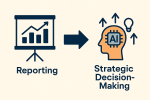
Another common trap is measuring activity rather than outcomes. These days, organizations proudly report the number of tokens used, experiments conducted, prompts executed, or AI tools adopted. Those metrics may indicate engagement, but they don’t necessarily indicate value. The questions leaders should be asking are much simpler: Did customer satisfaction improve? Did operational costs decrease? Did revenue increase? Did employee productivity improve? AI creates value only when it is connected to measurable business outcomes. Everything else is experimentation. That’s why I recommend that organizations regularly review AI adoption, engagement, and ROI through existing governance forums such as Monthly Product Reviews (MPRs), Monthly Business Reviews (MBRs), Engineering Operations Reviews, and Level 10 (L10) meetings. These forums help connect AI initiatives to measurable business outcomes, making it easier to understand what’s creating value, what’s falling short, and where organizations should focus their next investments.
As organizations mature, AI governance becomes increasingly important. Unfortunately, AI governance has developed a bad reputation and is often viewed as the enemy of innovation, since AI models are evolving at an unprecedented pace, heavyweight governance processes often struggle to keep up. In reality, governance is what allows innovation to scale safely. Whether it’s privacy, security, compliance, responsible AI, or human oversight, organizations need clear and repeatable processes that help teams move quickly while managing risk responsibly. The Air Canada chatbot incident serves as a reminder that companies remain accountable for what their AI systems do, regardless of how autonomous those systems may appear. Thus, I recommend that organizations rethink their decade-old governance models. Since AI is evolving rapidly, innovators should not have to navigate multiple approvals and disconnected stakeholders just to get an AI use case reviewed. Instead, organizations should establish a centralized governance forum where teams can bring ideas, ask questions, receive timely guidance, and understand the rationale behind governance decisions. The goal is not to reduce oversight, but to streamline it. By creating a transparent, well-socialized, and operationalized governance framework with regular follow-ups and clear communication, organizations can strengthen governance while simultaneously accelerating the pace of innovation.
Another common mistake organizations make is failing to invest in their people. Like any major transformation, AI augmentation is ultimately a transformation of how people work. Simply providing access to AI models or GenAI tools does not guarantee success. Organizations need to invest heavily in AI literacy, change management, coaching, upskilling, and adoption strategies, just as they would for any other enterprise-wide transformation. Leaders cannot assume that because AI tools are available, employees will automatically use them effectively or that productivity will magically improve. Without the right training, guidance, and support, most employees will either underutilize AI or use it only for basic tasks. Employees need to understand where AI can help, where it cannot, and how to integrate it into their daily workflows responsibly and effectively. After all, if people continue to view AI as nothing more than a chatbot, the vision of building AI-powered assistants, autonomous workflows, and agentic AI solutions will remain out of reach. This is why leaders must build an operating model that reinforces the right behaviors, creates opportunities for learning, and encourages adoption through the right incentives. Ultimately, AI transformation is not a technology transformation. It is a people transformation.
Finally, organizations need to answer one critical question: When AI fails, who is accountable? As tools like Claude, Gemini, Cursor, and GitHub Copilot become part of everyday software development, accountability can quickly become blurred. My view is straightforward. AI can generate content, code, and recommendations, but it cannot own responsibility. The engineer who deploys the code remains accountable for its quality. The product manager who launches the feature remains accountable for its business impact. Human ownership must remain intact, regardless of how much AI contributed to the solution.
The biggest obstacle preventing companies from realizing value from AI isn’t model performance or innovation. It’s the absence of an AI operating system that connects governance, measurement, accountability, data readiness, and talent development into a repeatable framework. AI doesn’t reduce our need for leadership, governance, operational excellence, or execution discipline. It increases it.