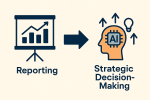
Early in my career at a couple of Fortune 500s, program management excellence often meant one thing: being able to produce a clean, defensible status report. Green boxes built credibility. Red ones triggered escalation. The irony was that by the time something turned red, everyone already felt the pain, the report simply made it official.
Fast forward to today, use of AI often exposes an uncomfortable truth: much of what we call program management has been information movement, not decision support. Startups figured this out long ago. They don’t have the luxury of formal status cycles; they rely on shared situational awareness. AI finally allows large organizations to do the same without collapsing under scale.
What changes is not visibility, but interpretation. AI is extremely good at synthesizing fragmented signals into a coherent story. That’s something PMOs have historically tried to do manually, often under time pressure and political constraints.
In most of these big tech giants, I have often seen programs where risk doesn’t emerge explosively, it creeps. A dependency slips a sprint. A scope assumption quietly changes. A team compensates heroically. None of this is “red,” but all of it matters. AI excels at spotting these slow burn patterns precisely because it doesn’t get tired, defensive, or distracted by hierarchy.
Thus, I have been extensively using AI into my day-to-day activities by replacing weekly status decks with weekly sense‑making narratives. Instead of asking teams to explain why something is red or green, I have been using Rovo and Cursor to ask questions like: What’s drifting from plan but not yet obvious? What commitments are most vulnerable if nothing changes? These questions provoke far better conversations, provide helpful insights to the leadership team, and help the core project team to maneuver challenges.
The practical change required to implement this workflow is surprisingly small. You just need to enable Rovo agent in JIRA, work with your teams to fix JIRA hygiene challenges, and connect Cursor with your Atlassian suite. Once you do the groundwork, you can then feed AI your existing artifacts like Jira updates, roadmap changes, sprint notes, and ask it to generate insights rather than summaries. You can then review these insights and share it with your teams. This workflow and its visibility will fundamentally change how your teams operate. Over time, teams will stop optimizing for optics and start optimizing for coherence.
So, I strongly believe that AI won’t make program managers irrelevant, but it will make them more like strategists and less like couriers. The PMO of the future won’t be judged by how accurate its reports are, but by how early it helps leaders see reality and help them win through data driven decision making.